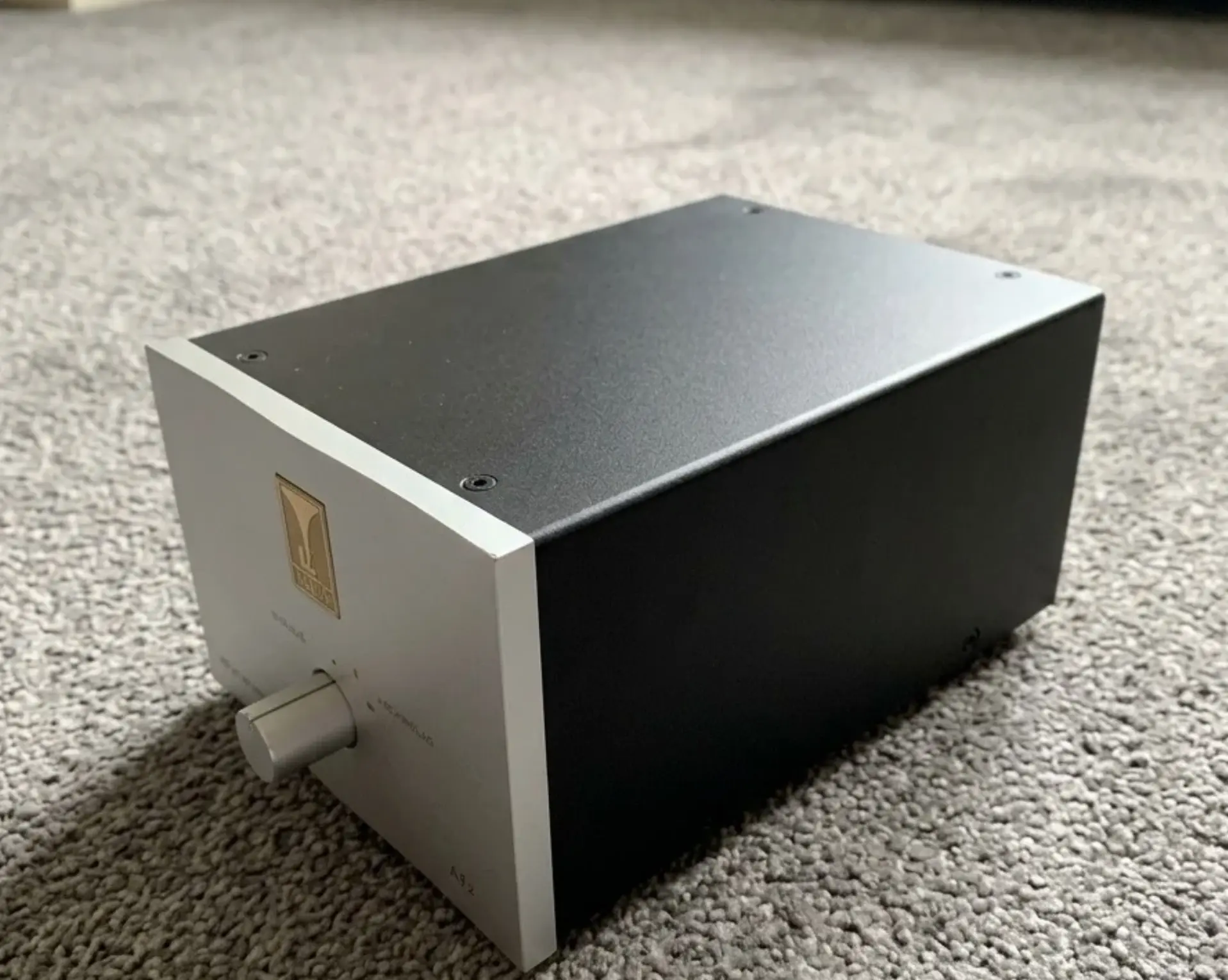
MC Step-Up Transformer (SUT): How It Works and Whether You Need One
An MC step-up transformer (SUT) is a passive device that raises the tiny output voltage of a moving coil cartridge so it can feed the MM input of a phono preamp. A good SUT can deliver very low noise and flexible impedance matching, but it is not automatically better than a built-in MC stage. It depends on the cartridge, the turns ratio and the phono stage.
Key Takeaways
- A SUT steps up a low-output MC cartridge signal (about 0.2–0.5 mV) for an MM input.
- A 1:10 ratio gives about 20 dB of gain and a 1:20 ratio about 26 dB.
- The turns ratio also sets the load the cartridge sees (47 kΩ ÷ ratio²).
- Core, windings and shielding determine the quality of a transformer.
- Neither a SUT nor an active MC stage is universally better. Matching matters most.
What Is an MC Step-Up Transformer?
Moving magnet (MM) cartridges typically produce around 3–5 mV. Low-output moving coil (MC) cartridges often deliver only 0.2–0.5 mV, so their signal needs far more gain before RIAA equalisation.
An MC step-up transformer is a passive component that uses electromagnetic induction to raise the cartridge’s output voltage. It needs no power supply and no active gain stage. Two windings and a magnetic core transfer the signal from the cartridge to the phono preamplifier.
The boosted signal lets you connect a low-output MC cartridge to the MM input of a conventional phono stage, which then applies RIAA equalisation and further amplification.
Why Do Audiophiles Use a Step-Up Transformer?
If you own a cartridge from Ortofon, Lyra or Koetsu costing $4,000 or more, you want to get every detail from it. Your phono preamp may have an MC input, but that doesn’t guarantee the best match.
An external SUT can offer:
- Excellent noise performance
- Effective impedance matching
- A different sonic character, which many listeners enjoy
- A simple, passive signal path with no powered gain stage between cartridge and MM input
Quality varies enormously, and three elements matter most: the core, the windings and the shielding.
What Makes a Good MC Step-Up Transformer?
1. The Magnetic Core
The core provides the magnetic path between the primary and secondary windings. Its material and construction influence inductance, bandwidth, distortion and how well the transformer handles very small signals.
High-end designs may use nickel alloys, valued for high magnetic permeability, or amorphous metals, made by cooling molten material so rapidly that no conventional crystalline structure forms. Core geometry and lamination matter too, which is why two transformers with similar specs can sound different.
2. Windings: Copper, Silver and Construction
The primary winding connects to the cartridge and the secondary to the phono preamp. The turns ratio sets the voltage gain: a 1:10 SUT gives roughly 20 dB, and a 1:20 SUT roughly 26 dB.
Some manufacturers use selected copper, others silver. Audio Note and Kondo are well known among enthusiasts for their transformer construction. Winding technique is just as important, because poor winding can add capacitance and leakage inductance, which hurts frequency response and high-frequency performance.
3. Shielding and Placement
A SUT can pick up hum from nearby power supplies and mains transformers. Good designs use magnetic and electrostatic shielding in a carefully built enclosure. Potting compounds, wax or resin help with mechanical stability and insulation, but they are not magnetic shielding.
Keep your SUT away from power transformers and amplifiers. In a high-resolution system, even slight background noise is audible in quiet passages.
Why Can a SUT Sound Quieter Than an Active MC Stage?
An active MC stage must amplify a very small signal electronically, so its first gain stage has to be exceptionally quiet. Every resistor and transistor adds some noise.
A passive transformer raises voltage through induction instead, so it doesn’t add the same kind of electronic noise. It isn’t noise-free, though: winding resistance, core losses and external interference still matter, and the turns ratio affects system noise as well.
Paired with a good MM phono stage, a well-matched SUT can give a darker background, clearer detail and a greater sense of space around instruments.
How to Match a SUT to Your MC Cartridge
An MC cartridge has low output voltage and low internal impedance, while an MM input is designed around a nominal 47 kΩ load. The transformer bridges that gap and also changes the load the cartridge sees:
| Turns ratio | Voltage gain | Reflected load (from 47 kΩ) |
|---|---|---|
| 1:10 | ~20 dB | ~470 Ω |
| 1:20 | ~26 dB | ~117.5 Ω |
These are theoretical figures before real-world effects such as winding resistance, leakage inductance and capacitance.
Choosing a SUT is not about picking the most gain. The ratio must suit your cartridge’s output voltage, internal impedance and recommended load. Too much gain can overload the MM input, and the wrong load can change the cartridge’s frequency response.
Galvanic Isolation
A SUT’s windings are electrically separate, and the signal crosses by magnetic field. This can break some ground-loop paths and reduce certain kinds of interference. It does not eliminate every grounding problem, so proper grounding, shielding and layout still matter.
SUT vs Active MC Phono Stage: Which Is Better?
| External SUT | Active MC Phono Stage | |
|---|---|---|
| Signal path | Passive voltage transformation | Electronic amplification |
| Input used | MM input of your phono stage | Built-in MC input |
| Loading | Set by turns ratio and load | Often adjustable |
| Extra component | Yes | No |
| Best for | Experimenting with cores, windings, ratios | Convenient gain and loading adjustment |
Both can deliver excellent results, depending on component quality and electrical compatibility. The best choice is the one that works properly with your cartridge and phono preamp.
Is an MC Step-Up Transformer Worth It?
A transformer isn’t automatically better than a built-in MC stage. The cartridge, turns ratio, loading, MM input and overall circuit quality all have to work together. When they do, the results can be wonderful.
For me, the real attraction is how a well-matched analogue system lets you forget the equipment. You notice the reverberation of a recording venue, the texture of a double bass, the tension in Coltrane’s playing and Paul Chambers’ fingers working against the strings.
Enjoy the music!